A 2mW 0.7V 720p H.264 Video Decoder

Image of chip design
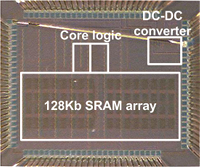
This 65nm ASIC demonstrates several architectural optimizations such as increased parallelism, multiple voltage / frequency domains and custom voltage-scalable SRAMs that enable low voltage operation and reduce the power of a high definition video decoder.

A 65nm Subthreshold System-on-chip

Image of chip design
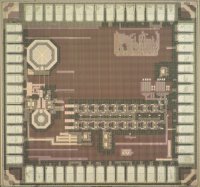
This is a subthreshold system-on-chip consisting of a 16-bit MSP430 microcontroller, SRAM, and on-chip DC-DC converter. The microcontroller and SRAM are designed to operate between 0.3V to 0.6V to support severely energy constrained applications. The switched capacitor DC-DC converter is fully integrated on chip and provides a wide range of load voltages (0.3V-1.1V) at > 70% efficiency.

A Reconfigurable 8T Ultra-Dynamic Voltage Scalable (U-DVS) SRAM in 65 nm CMOS

Image of chip design
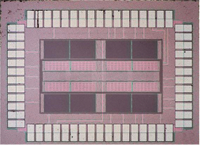
In modern ICs, the trend of integrating more on-chip memories on a die has led SRAMs to account for a large fraction of total area and energy of a chip. Therefore, designing memories with dynamic voltage scaling (DVS) capability is important since significant active as well as leakage power savings can be achieved by voltage scaling. However, optimizing circuit operation over a large voltage range is not trivial due to conflicting trade-offs of low-voltage (moderate and weak inversion) and high-voltage (strong inversion) transistor characteristics. Specifically, low-voltage operation requires various assist circuits for functionality which might severely impact high-voltage performance. Reconfigurable assist circuits provide the necessary adaptability for circuits to adjust themselves to the requirements of the voltage range that they are operating in. This work presents a 64 kb reconfigurable SRAM fabricated in 65 nm low-power CMOS process operating from 250 mV to 1.2 V. This wide supply range was enabled by a combination of circuits optimized for both sub-threshold and above-threshold regimes and by employing hardware reconfigurability. A prototype test chip is tested to be operational at 20 kHz with 250 mV supply and 200 MHz with 1.2 V supply. Over this range leakage power scales by more than 50 × and a minimum energy point is achieved at 0.4V with less than 0.1 pJ/bit/access.

A 19pJ/pulse UWB Transmitter with Dual Capacitively-Coupled Digital Power Amplifiers

Image of chip design
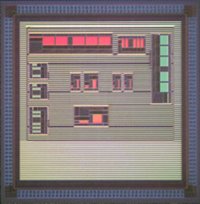
A pulsed ultra-wideband transmitter operating in the 3-to-5GHz band is designed in 90nm CMOS. The all-digital architecture generates pulses by capacitively combining two paths which have in-phase RF signals, yet have counter-phase common-mode components that are canceled. This technique results in FCC-compliant pulse generation without requiring the use of any off-chip filters. The transmitter operates at a maximum data rate of 15.6Mbps, requires a core area of 0.07mm2, and achieves an energy efficiency of 19pJ/pulse.