SHARC: Self-Healing Analog with RRAM and CNFETs

Image of chip design
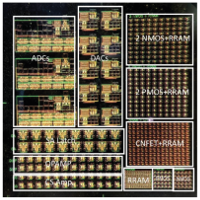
Carbon nanotube (CNT) field-effect transistors (CNFETs) are a promising emerging technology for energy-efficient electronics. Despite this promise, CNTs are subject to substantial inherent imperfections; every ensemble of CNTs includes some percentage of metallic CNTs (m-CNTs). m-CNTs result in conductive shorts between CNFET source and drain, resulting in excessive leakage and degraded (potentially incorrect) circuit functionality. Several techniques have been developed to remove the majority of m-CNTs (no technique today removes 100% of m-CNTs). While these techniques enabled the first digital CNFET circuits, it is still not possible to realize large-scale CNFET analog or mixed-signal CNFET circuits due to m-CNTs. While a digital logic gate can still function correctly in the presence of a small fraction of m-CNTs (but with degraded resilience to noise), a single m-CNT in an analog circuit can result in catastrophic failure (e.g., degrading amplifier gain resulting in functional failure of circuit blocks such as ADCs and DACs). This work presents a circuit design technique, Self-Healing Analog with RRAM and CNFETs (SHARC), that leverages the programmability of non-volatile resistive RAM (RRAM) to automatically “self-heal” analog circuits in the presence of m-CNTs. Using SHARC, we experimentally demonstrate analog CNFET circuits robust to m-CNTs as well as the first mixed-signals CNFET sub-system (4-bit DAC and SAR ADC; these are the largest reported complementary (CMOS) CNFET circuit demonstrations to-date).


An Energy-Efficient Configurable Lattice Cryptography Processor for the Quantum-Secure Internet of Things

Image of Chip design
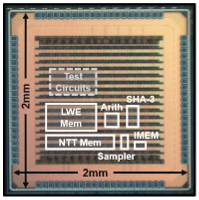
Modern public key protocols, such as RSA and elliptic curve cryptography, will be rendered insecure by Shor's algorithm when large-scale quantum computers are built. Therefore, cryptographers are working on quantum-resistant algorithms, and lattice-based cryptography has emerged as a prime candidate. However, high computational complexity of these algorithms makes it challenging to implement lattice-based protocols on resource-constrained IoT devices, which need to secure data against both present and future adversaries. To address this challenge, we present a lattice cryptography processor with configurable parameters, which enables up to two orders of magnitude energy savings and 124K-gate reduction in system area through architectural optimizations. The ASIC demonstrates multiple lattice-based protocols proposed in the NIST post-quantum standardization process.

SHARC: Self-Healing Analog with RRAM and CNFETs

Image of chip
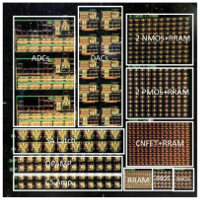
Carbon nanotube (CNT) field-effect transistors (CNFETs) are a promising emerging technology for energy-efficient electronics. Despite this promise, CNTs are subject to substantial inherent imperfections; every ensemble of CNTs includes some percentage of metallic CNTs (m-CNTs). m-CNTs result in conductive shorts between CNFET source and drain, resulting in excessive leakage and degraded (potentially incorrect) circuit functionality. Several techniques have been developed to remove the majority of m-CNTs (no technique today removes 100% of m-CNTs). While these techniques enabled the first digital CNFET circuits, it is still not possible to realize large-scale CNFET analog or mixed-signal CNFET circuits due to m-CNTs. While a digital logic gate can still function correctly in the presence of a small fraction of m-CNTs (but with degraded resilience to noise), a single m-CNT in an analog circuit can result in catastrophic failure (e.g., degrading amplifier gain resulting in functional failure of circuit blocks such as ADCs and DACs). This work presents a circuit design technique, Self-Healing Analog with RRAM and CNFETs (SHARC), that leverages the programmability of non-volatile resistive RAM (RRAM) to automatically “self-heal” analog circuits in the presence of m-CNTs. Using SHARC, we experimentally demonstrate analog CNFET circuits robust to m-CNTs as well as the first mixed-signals CNFET sub-system (4-bit DAC and SAR ADC; these are the largest reported complementary (CMOS) CNFET circuit demonstrations to-date).
An Energy-Efficient Configurable Lattice Cryptography Processor for the Quantum-Secure Internet of Things

Image of Chip design
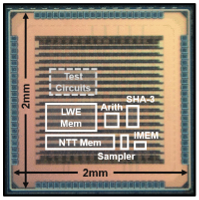
Modern public key protocols, such as RSA and elliptic curve cryptography, will be rendered insecure by Shor's algorithm when large-scale quantum computers are built. Therefore, cryptographers are working on quantum-resistant algorithms, and lattice-based cryptography has emerged as a prime candidate. However, high computational complexity of these algorithms makes it challenging to implement lattice-based protocols on resource-constrained IoT devices, which need to secure data against both present and future adversaries. To address this challenge, we present a lattice cryptography processor with configurable parameters, which enables up to two orders of magnitude energy savings and 124K-gate reduction in system area through architectural optimizations. The ASIC demonstrates multiple lattice-based protocols proposed in the NIST post-quantum standardization process.