A Single-Chip Ultra-Wideband Transceiver

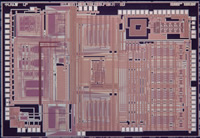
Image of chip design
This is one of lab's first UWB-related chip, consisting of a LNA, a FLASH time-interleaved ADC, a self-biased PLL, and a digital baseband. This CMOS chip integrates a complete wireless transceiver system working in the 0-to-500 MHz ultra-wideband.

Substrate Noise Characterization

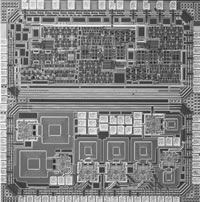
Image of chip design
Substrate noise is a major problem that plagues mixed-signal circuits. Parasitic interactions from switching digital circuits propagate via the shared substrate to sensitive analog circuits adversely affecting performance. A chip was designed to characterize substrate noise generated by digital circuits as well as to study the effect of substrate noise on the performance of a standard component of the RF front-end, the voltage controlled oscillator (VCO). The chip was fabricated in a 0.18 µm CMOS mixed-signal process.

Energy Scalable FFT Chip

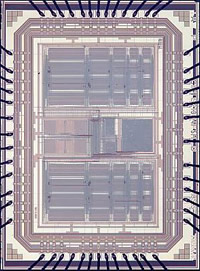
Image of chip design
The scalable FFT chip demonstrates energy-aware architectures. An energy-aware architecture is used to scale gracefully between energy and quality. The architecture has variable bit precision logic (multipliers, adders, etc.), memories (RAM and ROM) and a variable memory size, in order to compute 128-1024-pt FFT lengths and between 8- and 16-bit precision FFT's.

µAMPS-1 Node

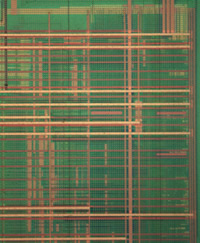
Image of chip design
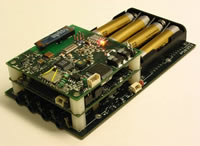
The µAMPS-1 microsensor node uses commercial, off-the-shelf (COTS) components for rapid construction. A µAMPS-1 node consists of a stack of three or four printed circuit boards. The top board contains the radio, including the RF circuitry and the FPGA used for digital coding and decoding. The second board contains an Intel StrongARM processor and associated RAM and flash ROM. Also on the processor board are an acoustic sensor (microphone, amplifier, filter, and analog-to-digital converter) and a collection of dc/dc power converters that service the entire node. The optional third board in the stack is an additional sensor module to replace the acoustic sensor on the processor board. The µAMPS-1 node can be easily adapted to different applications by designing an appropriate sensor board.